The inimitable Jev
A field note from the margin of the news, the third of its kind after Aladdin’s lamp and AGI is coming. It reads what has been published about a new product, and ends at my own bench, where a local version of it now runs.
The title is a pun on The Inimitable Jeeves, P. G. Wodehouse’s 1923 collection of stories about a valet who says little, is asked everything, and is always right. TypeSafe AI named its product after someone else: William Stanley Jevons, whose paradox says that making coal cheaper to burn increases the coal burnt, and the bill with it. Both references fit. The product gives short answers and no commentary, and the company is betting that making a decision cheap will multiply the number of decisions people ask a machine to make. The word inimitable is my irony. In the week after the launch, more than ten open-source projects set out to imitate it.
What Jev is
TypeSafe launched Jev on 15 September 2026. It is a paid API with a single endpoint. You send a piece of text, which TypeSafe calls the state, and a set of questions about it. Each question has one of three types: a choice among up to 255 named options, a score on a scale of two to ten levels, or a noul, a yes-or-no answer given as a probability. Every answer comes back typed, with a probability for each option and a confidence. Nothing comes back as prose.
The launch post borrows Daniel Kahneman’s distinction between fast, intuitive System 1 thinking and slow, deliberate System 2 reasoning, and places Jev on the System 1 side. The frontier models are built for the other side: long reasoning, long answers, agents that run for hours. Jev is meant to be called thousands of times inside a program, where a program needs a judgement and has no use for an essay.
Three numbers carry the pitch. The response time is 70 to 500 milliseconds. Input costs $0.042 per million tokens. Output is listed as free, “too cheap to meter”. What produces those numbers is not public. The launch post mentions “a new model architecture” with a “parallel sampler” and a training method for calibrated answers, and names no model family and no size. MarkTechPost’s summary is that TypeSafe “has not disclosed the architecture”.
The people behind it are not outsiders. The CEO, Diogo Almeida, writes in the launch post that at OpenAI he “helped build the methods that made language models useful at following instructions”. TypeSafe came out of stealth with a $40 million seed round led by DCVC.
A week of attention
The Hacker News thread was reported at more than 1,800 points and 480 comments within two days. TypeSafe opened sign-ups to everyone on 20 September and paused them on 22 September, citing demand. It has published no sign-up numbers.
The imitators came faster. An independent catalogue, systemonemodels.org, lists about 35 alternatives. The most visible open-source clone, Laya, went from nothing on 18 September to more than 20,000 GitHub stars five days later. Two others, kev and SemIf, are between 4,000 and 6,000.
Stars measure attention, not accuracy. Flowtivity, a consultancy that deploys Laya for its clients, tested it and reported that “the zero-shot base model scores 0.362, below the 0.461 majority-class baseline”. A classifier that always answered the most common class would have done better. The 0.766 that circulates is from a checkpoint trained on the benchmark’s own training split. Independent measurements of Jev are few and small. Mariya Mansurova, writing in Towards Data Science, tested it on a banking task with 77 intents and measured 79.0% accuracy, against 83.9% and 86.2% for two OpenAI models, at almost twice their speed. On a reduced version of the task with seven labels, the three were roughly on par.
The new part and the old part
Classifying text without training a classifier is not new. Zero-shot classification by natural-language inference has been a standard library call for years, and anyone with access to a language model’s token probabilities could read a label off them. OpenAI’s API offered a classifications endpoint by 2021; the company announced its deprecation in June 2022 and shut it off in December 2022. What changed my view of Jev was not the capability. It was the packaging.
A developer today who wants one yes-or-no judgement from a frontier model calls a service built for conversation. The model writes its answer token by token, the answer has to be parsed, and the bill is largest for the output, which is the part the developer least needs. Jev turns that inside out. The question is a data structure, the answer is a typed value with a probability attached, and the price falls on the input. The frontier labs charge by the length of what the model says. Jev charges by the length of what it reads.
Two thoughts follow, and I hold both as suspicions. The first is that there is a large demand for AI in small pieces. The frontier models are remarkable, and a developer building an application often needs a fraction of their power, many times a second, at a price that allows it to be called on every row. The second is that cutting a model into small pieces well is not a simple task. If the same scaling logic applies to it as to the large models, this becomes a market with a few winners too, and one whose revenue grows with the number of questions asked rather than the length of the answers. The name TypeSafe chose says it expects exactly that.
How the imitators work
Because Jev’s architecture is not public, every imitator is a guess. The guesses fall into two families.
The first uses a small encoder, a model of the BERT kind in which every word of the input sees every other. Laya places one masked slot per option and scores all the options in a single pass. OpenDecision and Verdict use similar ModernBERT backbones of 150 to 400 million parameters. These models are fast, and they run on an ordinary CPU. The Flowtivity result shows their weakness: without broad training on many tasks, they do poorly on a question they have not seen.
The second family takes an instruction-tuned language model, most often a Qwen, and reads its answer directly off the probabilities it assigns to each option. The model never writes a sentence. It reads the text, the question and the options in one parallel pass, and the scores for the options are read at the last position. That is the same shape of computation as the encoder’s, which surprised me when I worked it out: the imitators built on generative models do not generate. One project, open-jev, uses Google’s DiffusionGemma, a diffusion language model, which is a third shape again.
The real difference between the two families is size and training. The encoder is small and has to be trained for the task. The language model is ten to thirty times larger and follows instructions it has never seen.
On my bench
My instinct with a new tool is to put it on the bench, so I built a local version and called it mettilo_qui, Italian for “put it here”. It speaks the same request format as Jev, runs a Qwen3 4B model at 4-bit precision on my laptop, and answers from inside Impromptu, the spreadsheet engine I use for everything on this site. The first thing I built with it is a playground model: eight short texts, six questions, and a grid of answers.
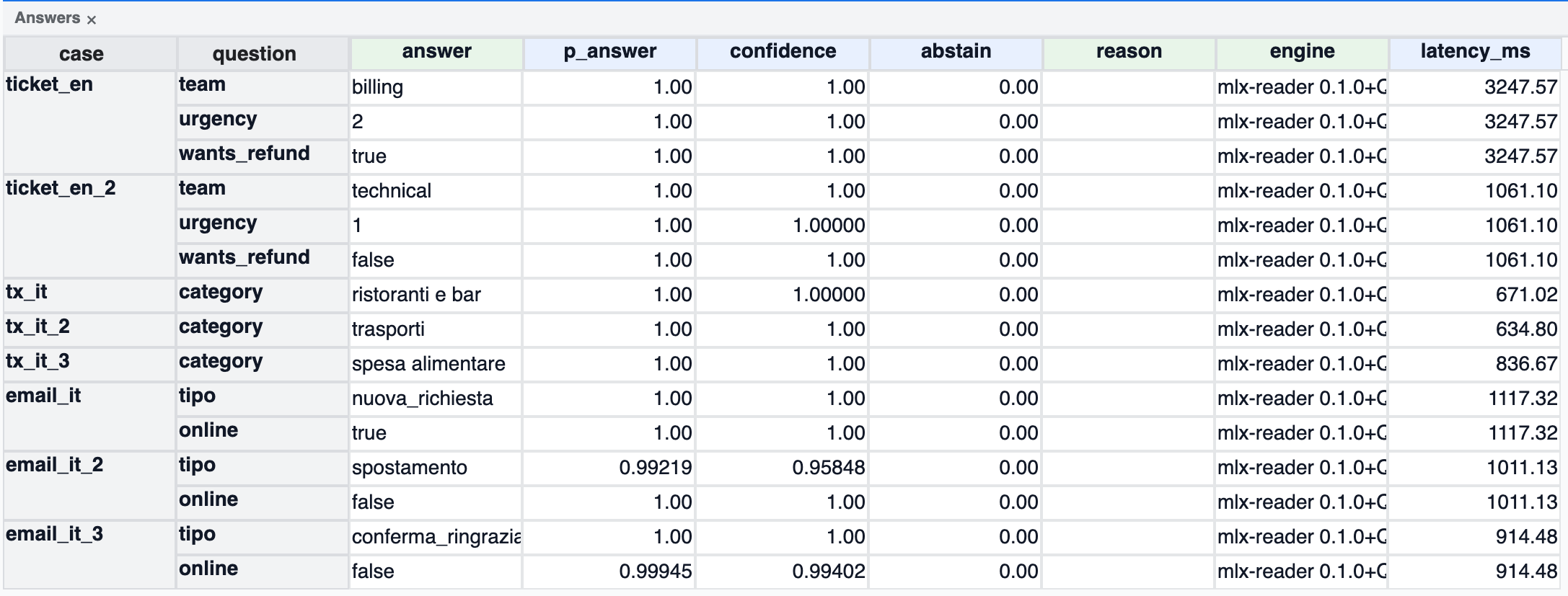
Some of the texts are English support tickets, as in TypeSafe’s own example. The others are the kind I actually deal with: Italian card transactions to be sorted into spending categories, and e-mails from students asking for an appointment. The transaction ADDEBITO CARTA TRENITALIA BIGLIETTO TRENTO-VERONA comes back as trasporti, and a student who writes that Thursday at three is no longer possible is correctly read as asking to move the meeting. Those data are the reason for a local version. My bank statements and my students’ e-mails do not leave my machine.
Two things in the grid matter more than the correct labels. The first is speed. Once the model is warm, each case takes between 0.6 and 1.1 seconds, which is slower than Jev’s upper bound and fine for a batch run overnight. The second is the probabilities. Almost every answer in the grid carries a probability of 1.00, including two I would not sign. A ticket that says “No rush, I can use the website for now” is scored as moderately urgent, where the natural reading is not urgent. A student reply I wrote on purpose to be ambiguous, “Va benissimo in presenza, grazie mille!”, which could be a confirmation or an answer about the place, is classified as a confirmation with no visible doubt.
A typed answer is easy to produce. An honest probability is the hard part, and it is what TypeSafe says it has trained for. My local model does not have it yet: every answer it gives is flagged as uncalibrated, and fitting its probabilities against labelled examples is the next piece of work.
What I expect to learn
I have no urgency to decide whether open models will close the gap, or whether the large labs will add a decision endpoint of their own. I want to understand the thing, and the bench is how I do that. The local version is going next to a real task, the categories of my own household transactions, where a year of labelled rows can say how often it is right and whether its confidence means anything. The results, and the mechanics of reading an answer off a language model without letting it speak, will be episodes of the ABC of LM series.
Sources: TypeSafe AI, Introducing System One models and Jev, the API reference and the team page; MarkTechPost, TypeSafe AI releases Jev; Firecrawl, What is Jev; Flowtivity, Laya, an open-source Jev alternative; Towards Data Science, Mariya Mansurova, A new kind of model for AI decision-making; OpenAI, Answers, Classifications and Search endpoint deprecation (June 2022); the alternatives catalogue at systemonemodels.org.