Artificial intelligence is not Aladdin’s lamp
A field note, not an essay — and the only one here about posture rather than machinery. The manifesto promises a bench where the work “stays legible even when an AI has its hands on it.” This is what that turns out to feel like from the inside, starting from an embarrassing confession.
You have probably caught yourself thinking it. I’d like to do this thing — let me just ask Claude, or Gemini, or ChatGPT. An article, maybe. A letter of recommendation. The opening talk for a seminar. And — wow — there it is, in thirty seconds, better than what would have taken you three hours.
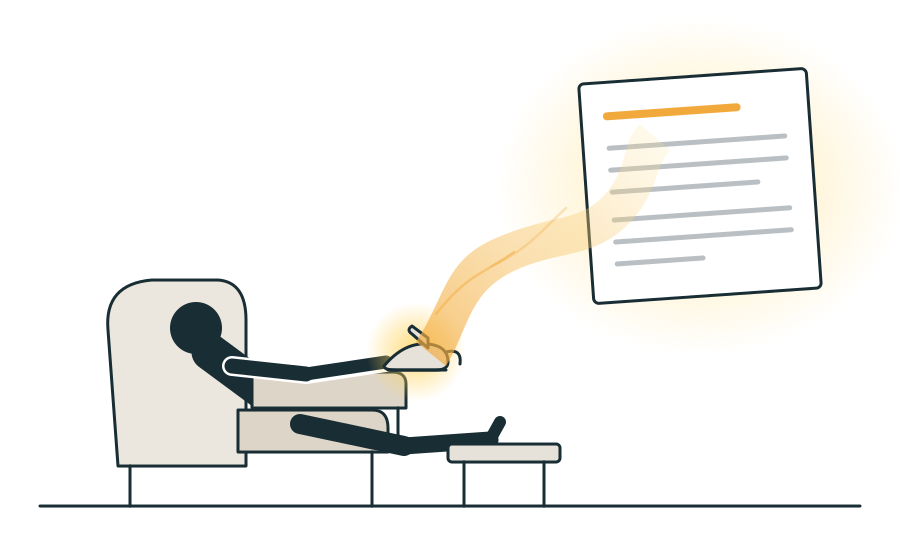
It happened to me, and I came down with what I can only call Aladdin’s syndrome — Aladdin of the lamp. You make a wish, you give the model a good rub with a prompt, and voilà: the object of your desire appears, as if by magic.
After the first moment of wonder — which can repeat itself once, twice, three times — the syndrome turns into a pathology. If a hidden genie keeps turning out work better than mine, what exactly am I still here for?
A pathology calls for a cure, and I found one. It wasn’t hard. Two things were enough: to attempt a piece of real work with AI, and to use it not for producing speeches and documents, but for carrying out tasks — activities with a tangible result.
The function either runs or it doesn’t
So I stopped asking for finished prose and started building something. The project is Impromptu, a spreadsheet engine for finance I have been developing, and my companion on the bench was Claude Code, working from the command line.
This is a different kind of conversation altogether. Here the model doesn’t hand you a polished paragraph you can admire and walk away from. It writes a function, and the function either runs or it doesn’t. It proposes an architecture, and you have to decide whether it fits the thing you are actually trying to build — because you are the only one who knows what that thing is. The result isn’t a text to be read; it is something that has to work. And when it doesn’t, there is no magic to hide behind. You debug, you reconsider, you say no, you try again.
That asymmetry is the whole cure, and it is worth saying plainly. Prose comes back and there is nothing to check it against, so you check it against your own taste — and your taste, flattered, waves it through. Code comes back and reality checks it for you, immediately, in public, without tact. The genie’s output stops being a gift and starts being a proposal.
You can watch this happen in Episode 1. I open a half-built leveraged-buyout model, type the assumptions, write four formulas by hand, and then describe in ordinary English what the income statement, the balance sheet and the cash-flow statement should do. The assistant writes the rest — some thirty formulas — and the three statements, which depend on each other in a circle, settle. The check line at the foot of the balance sheet, whose only acceptable value is zero, reads zero for every year.
That looks like a wish granted. It is not, and the difference is the point of this note. The engine’s formulas are readable, so I read them. The check line is there because I put it there — a model without one is a model whose author has not checked. The assistant reaches the engine through a small, deliberately narrow set of actions — create a dataset, set formulas, set values — precisely so that every move it makes has a name I can audit afterwards. None of that is the genie’s doing. It is the bench, built the way it was built so that the magic would have somewhere to land and something to answer to.
What I found at the bench
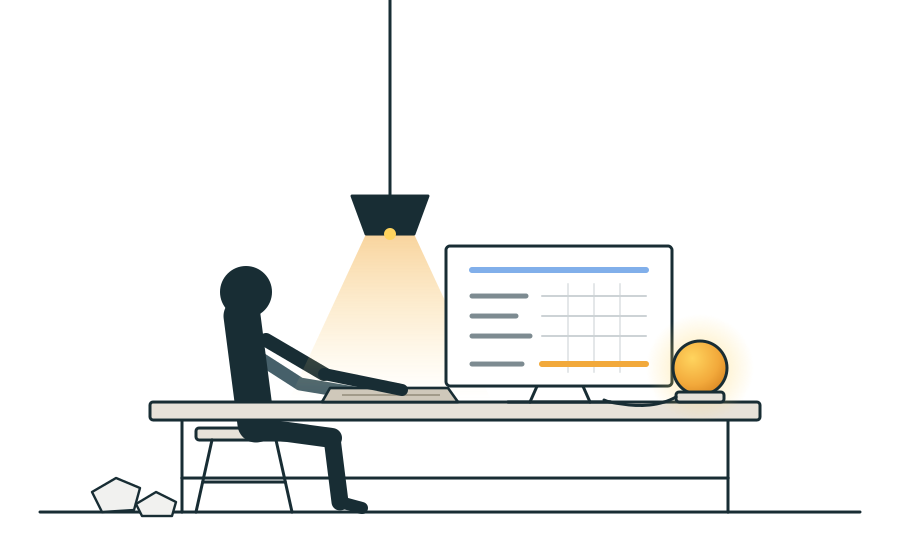
A remarkable working companion — who has to be told, by me, what I am trying to achieve. And not only at the start. Throughout the whole project. Take your hand off the wheel for a few turns and you drift; the direction is always mine to hold.
A reason to understand what AI genuinely knows and does to perfection — and, in the same motion, to sharpen my own technical English, and to discover the principles of software engineering I had only half-glimpsed before.
A pull toward being active and precise, both in the dialogue and in the doing. Strictly speaking, fragments would suffice — broken English, misspellings, half-finished words. The model would understand anyway. And yet I find myself writing in full, with capital letters and semicolons at the ends of lines. I like rediscovering the precision and the speed I had as a boy, learning to strike the keys of an Olivetti Lettera 22 with all ten fingers.
In other words: I am still the one who works, who expresses, who communicates, who produces and presents. I am the one who has to answer for myself.
An old story, I suspect, in a new costume
I have one bench and one trade, and I am wary of pronouncing on trades I have never practised — that is the sort of confident forecasting about “the future of work” this site explicitly refuses to do. But I will admit to a suspicion, offered as a suspicion.
Think of the airline captain, the autopilot holding the cruise steady for hours, who takes the controls himself when the runway comes up through the storm — because he, not the system, answers for every soul on board. I suspect that when a tool this good arrives in a craft, the craft does not disappear. It moves. It concentrates itself in judgment, in touch, in responsibility — in the part that stays stubbornly, irreducibly human.
Whether that is true of surgery or of translation, someone who does surgery or translation will have to tell you. What I can report is that it was true at my bench, and that I did not expect it to be.
In conclusion
With AI you do not work less. Quite the opposite: the intensity rises, and so does the depth. The genie does not relieve you of the work; it raises the floor of what counts as your work.
And what you make, in the end, remains yours.
If you want to see the bench rather than read about it, the LBO forecast is walked through end to end in Forecasting a company’s accounts and cash flow with an AI assistant, and the machine underneath — including exactly how the assistant is wired into it — is opened up in Impromptu under the hood.