Welcome to The Workbench
The manifesto for this site: what The Workbench is, what will appear here, and why a professor of corporate finance is building a modeling engine from scratch. The two-minute trailer below is the short version; the text is the long one.
Every workshop starts as a bench, a few tools, and a question that won’t leave you alone.
Mine is this: what happens to financial modeling when the model can explain itself — and when an AI can sit at the bench with you?
I am a professor of corporate finance at the University of Trento. For most of my career I have taught and done research with spreadsheets — and fought their two oldest defects: formulas that say =B7*C7 instead of Revenue × Margin, and logic so scattered across cells that nobody, including the author, can audit it a month later. The multidimensional spreadsheet tradition solved much of that: formulas written over named things, models whose structure you can read. It began with Lotus Improv — this project carries a tribute to it in its name — and lives on today in Quantrix Modeler, the environment of our Financial Planning Lab course at Trento for the past fifteen years, within a long-standing Academic Alliance with Quantrix. Everything I believe about transparent modeling — and everything I will demonstrate here — I learned at that bench, watching generations of students go from spreadsheet drudgery to models they could actually reason about. Quantrix remains our lab’s professional tool of choice, and nothing on this site changes that.
So why build something new? Because some questions can only be answered with an instrument you can take apart. Impromptu is the experiment at the center of this workbench: a prototype modeling engine, built from scratch, that takes the multidimensional ideas I have taught for years and asks what happens when you push them somewhere a professional product has no reason to go — onto the labeled-array data structures of scientific computing, with notebook-style reports inside the model, tiny machine-learning models as modeling exercises, and AI assistants wired directly into the engine, able to read and operate the model while you watch. Impromptu is not a product and not a replacement for the tools we teach with; it is a research vehicle, deliberately small and deliberately open to inspection. The point is the experiment, and the experiment is the content of this site. If you want to know what is actually running under the demonstrations, that is a separate note: Impromptu under the hood.
The AI connection deserves a plain statement, because it is the thread that ties this site together. Impromptu was built with AI assistance, and it is built for AI-assisted work: an assistant can open a model, set assumptions, write formulas, check results and draft the report — while you watch every step on screen and remain the one who decides. Not magic, not a black box: a workbench where the machinery stays legible even when an AI has its hands on it. What I learn from these experiments flows straight back into how I teach modeling — whatever the tool on the desk.
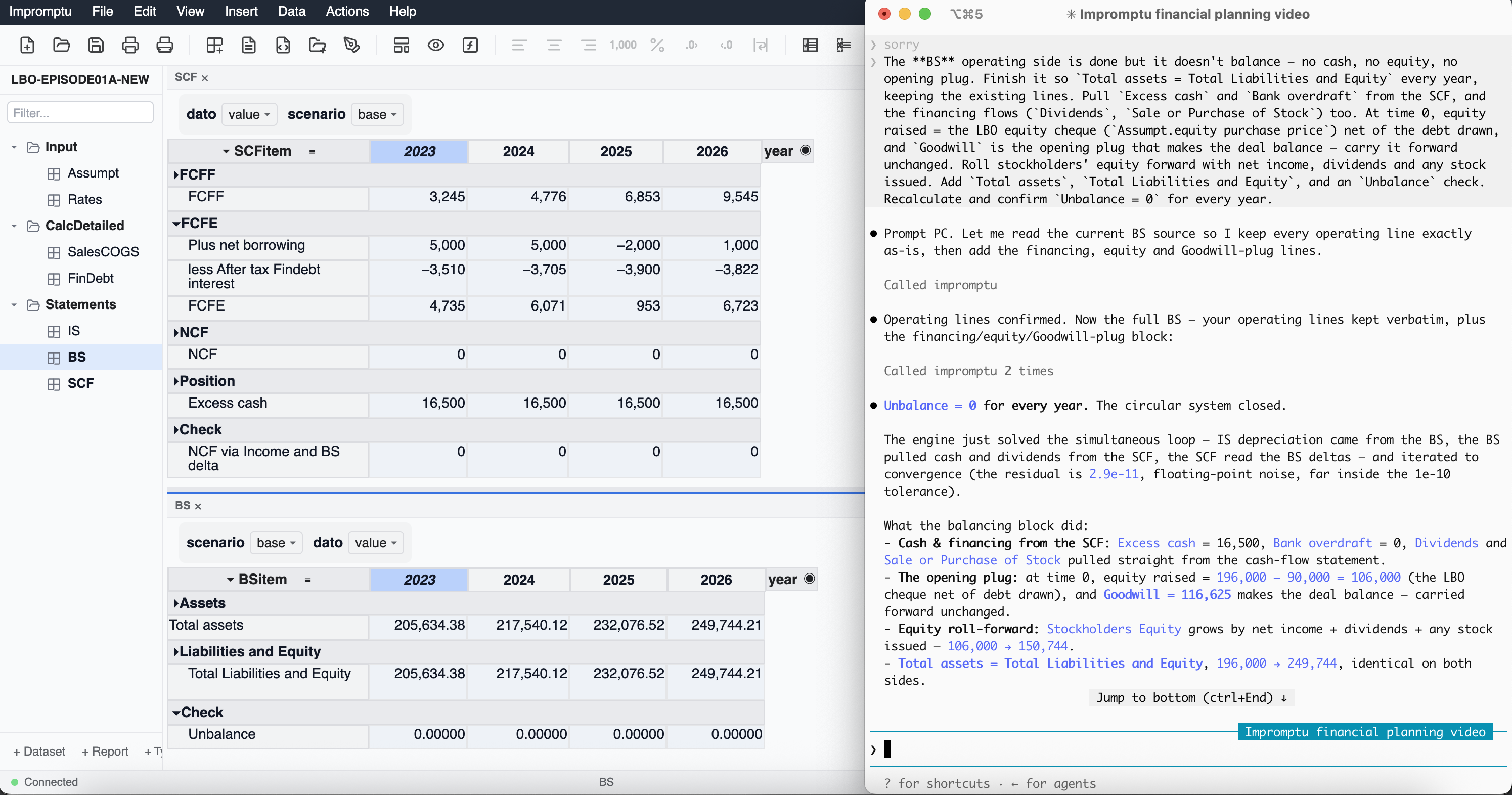
Unbalance reads zero for every year. Every step is visible, and every step is reversible.
What will appear here
Episodes, roughly every two weeks, each one a small self-contained piece of work: a model you can see, a video demonstration, and a written walk-through. Two series to begin with:
AI-assisted financial analysis. Real sessions where an AI assistant and I do the everyday work of finance — building a forecast income statement, analyzing financial statements — inside Impromptu. What works, what fails, where judgement still earns its keep.
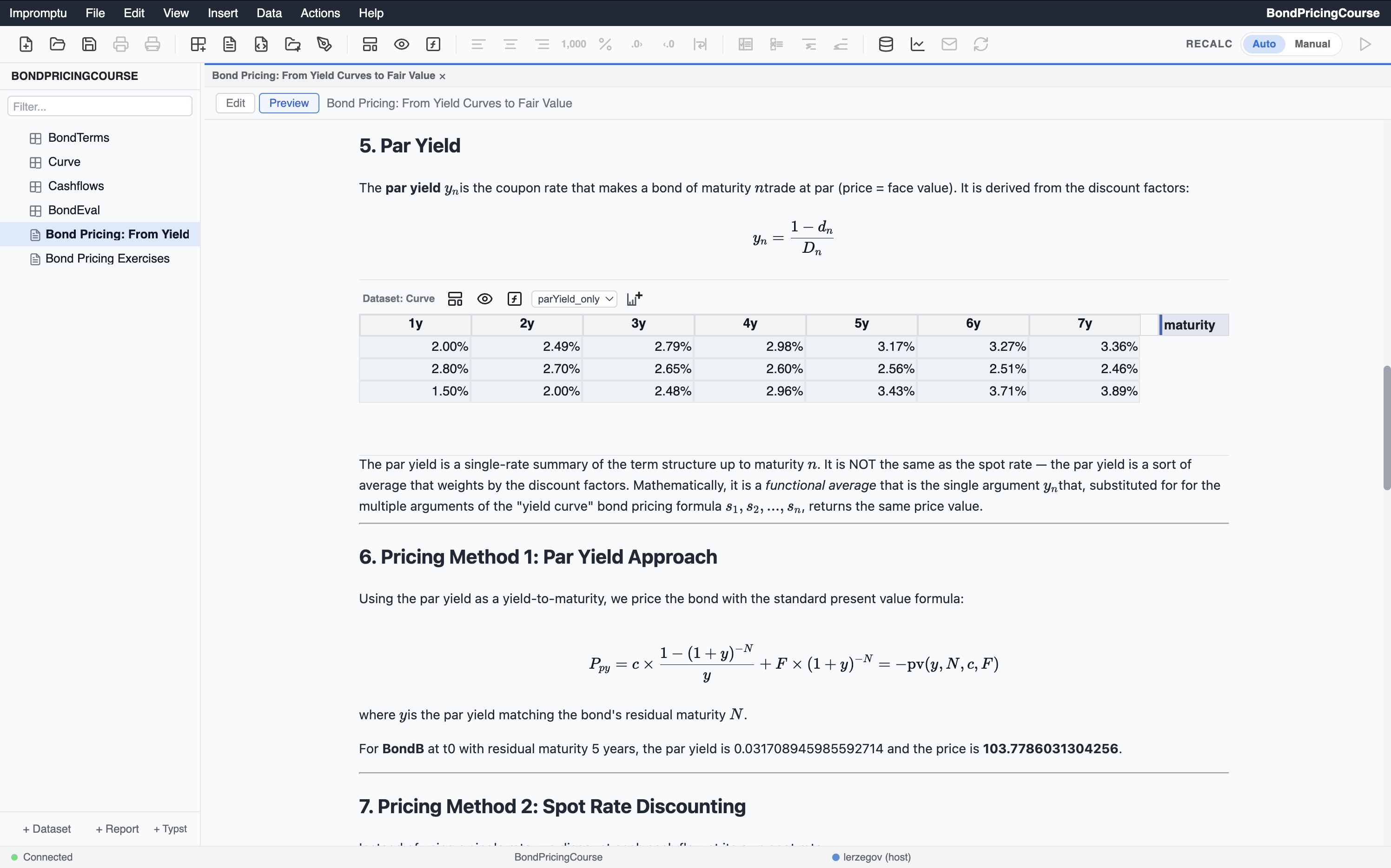
The ABC of language models. The series already underway here: tiny Transformer models, small enough to inspect completely, that show what attention, embeddings and next-word prediction actually do. If you use language models in management or finance, this is the intuition the demos and the hype both skip. Three long essays are already published — QKV Attention, Embeddings and the Maps We Draw of Them, and The Final Step — and videos of the tiny models in action come next.
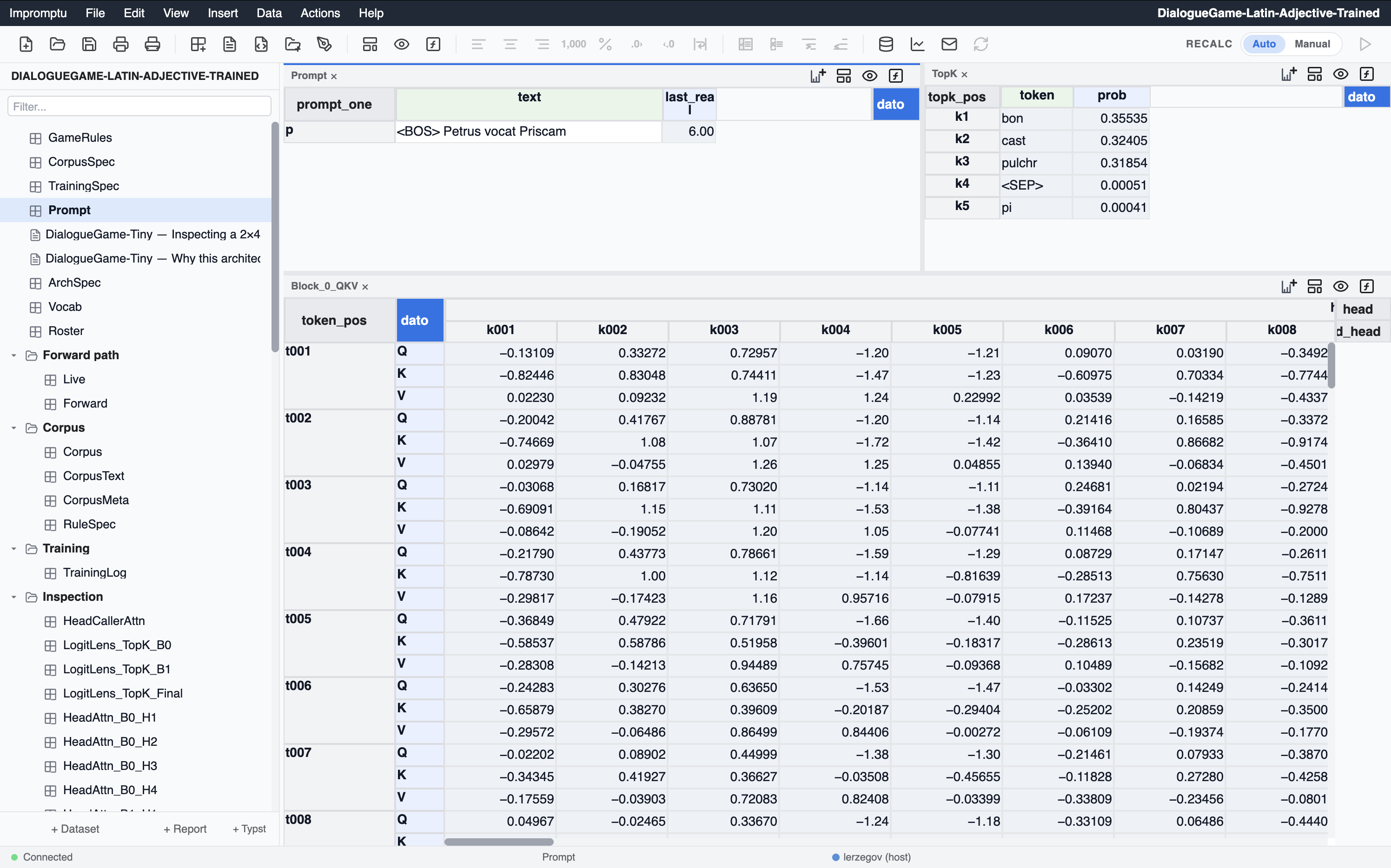
A third series, My finance class, starts with the academic year: the corporate-finance classics — capital budgeting, bond pricing, portfolio optimization, each built from a blank model, for students and for anyone who wants the fundamentals with every assumption visible.
Other projects — simulation of blockchain contracts, small machine-learning experiments, fuzzy expert systems — are on the shelf behind the bench. They will appear when they are ready, not before.
What this is not
I am not going to tell you whether AGI is near, or what AI means for the future of work, or which AI lab is winning the model race. Plenty of people are louder and more confident on those subjects. What I have is first-hand experience: an end user of frontier AI tools in daily research and teaching, and a hobbyist who builds tiny models to understand the big ones from first principles. The reports from that bench are what I can offer, and I think they are worth more than one more opinion.
Can I try Impromptu?
Not yet, by download. Impromptu is a working prototype; for now you will see it in action in every episode, and that is deliberate — I would rather show real work than ship an installation problem. A small group of early users will get hands-on access later this year; if that interests you, write to me and tell me what you would build with it.
Follow along
New episodes go up on the YouTube channel, and the full write-up is always here — free, no paywall. Everything permanent lives on this site.
And a word about the site itself, because the choice was deliberate. The Workbench is a handful of static files served from GitHub Pages. There is no advertising, no cookie banner to dismiss, no popup asking for your address, no paywall, and no recommendation engine deciding what you should look at next. The pages set no cookies; visits are counted by a small script that stores nothing and knows nothing about you. (Press play on a video and you are, unavoidably, in YouTube’s hands — which is why the players here are loaded in their no-cookie mode, dormant until you actually ask for one.)
Nothing here is optimized for reach. You arrived because someone sent you a link, or because you went looking — and that is the door I want people to come through. A workshop is a quiet place. It seemed only right that the site should be one too.
Welcome to The Workbench. The light is on.